
Gender Pay Gap Report 2025/26 (as at 31 March 2026)
GENERAL EXPLANATORY NOTES:
- ‘Gender Pay Gap’ (GPG) is not the same as ‘Equal pay’. The latter refers to the difference between men and women’s pay for the same job, and is illegal; whereas the gender pay gap relates to the difference calculated between average earnings, irrespective of their roles in any given sector, and is a way of measuring gender equality in respect of equal access to, and take up of, all types and levels of roles within an organisation.
- All calculations have been made as at 31 March 2026, in line with Government requirements for Public Sector bodies.
- Lancaster & Morecambe College does not have a bonus pay scheme for any staff, so reporting requirements for bonuses are not applicable.
- The mean calculation shows the difference between the mean average hourly rate of pay that male and female employees receive. Mean averages (division of total sum of all values by number of values) are useful because they place the same value on every number used, giving a good overall indication of the gender pay gap; however, very large or small pay rates can ‘dominate’ and distort the answer.
- The median calculation shows the difference between the median hourly rate of pay that male and female full-pay relevant employees receive. Median averages (middle point in a list of all values from smallest to largest) are useful to indicate what the ‘typical’ situation is i.e. in the middle of an organisation, and are not distorted by very large or small pay rates or bonuses. However, this means that not all gender pay gap issues will be picked up.
- Using these two different types of average is helpful to give a more balanced overview of an employer’s gender pay gap.
- Quartiles: comparing the two results in each quartile will indicate the distribution of male and female employees in the quartile. Comparing results between the quartiles will indicate the distribution of male and female employees across the organisation.
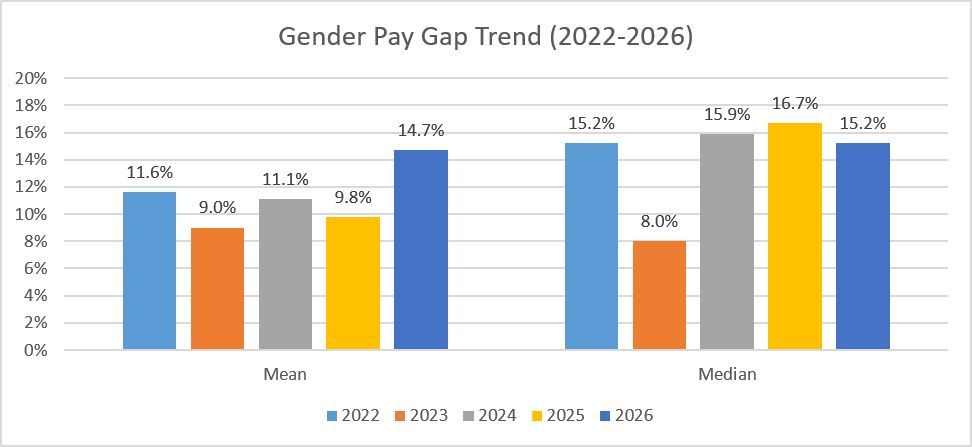
MEAN AVERAGE LMC Mean Gender Pay Gap is: 14.7%
MEDIAN AVERAGE LMC Median Gender Pay Gap is: 15.2%
QUARTILES
| Male | Female | |
| Lower Quartile (Q1) Lowest Paid | 21.8% | 78.2% |
| Lower Middle Quartile (Q2) | 33.3% | 66.7% |
| Upper Middle Quartile (Q3) | 34.6% | 65.4% |
| Upper Quartile (Q4) Highest Paid | 49.3% |
50.7% |
CAUSAL ANALYSIS: What has contributed to the 2026 position?
Analysis of the Mean GPG; This year’s data continues the pattern seen in recent years and should be considered in the context of the College’s overall staffing profile and the gender distribution across different levels of roles.
-
The gender and pay profile of the senior leadership team and Head of Finance continues to impact the gender pay gap.
-
In March 2026, the balance of apprentices and other lower paid roles continued to have a modest effect on the overall mean calculation, with lower-paid posts remaining more heavily represented by female staff.
-
In previous years, this report has detailed the impact of the Shortage Skills Allowance (SSA) paid to teaching staff in certain shortage skills areas. The highest SSA paid is £6000 per annum for some subject areas, mainly in Construction & Engineering. Although it includes a small number of female staff, the majority in receipt of the higher levels of SSA are male, due to the profile of the trades involved.
-
Other differences in the mean GPG are likely to reflect a combination of the contributory factors outlined in the median GPG analysis below.
-
The median gender pay gap in 2026 remains influenced by the distribution of women and men across lower, middle and higher paid roles, and continues to reflect the sensitivity of this measure within a relatively small workforce.
-
Recent pay awards and National Living Wage changes continue to affect pay levels across the organisation; however, because percentage uplifts apply across pay bands, the overall impact on the median gender pay gap remains shaped by where staff are distributed within the pay structure.
-
A high proportion of female staff work in lower paid support roles, which received lower actual pay increases in terms of hourly rate, albeit the same percentage increase.
Other factors potentially impacting the year-on-year fluctuations in GPG:
-
It is helpful to consider the distribution of female and male staff across the organisation, and the year-on-year fluctuations within this distribution. With the College’s relatively small number of staff, and nearly twice the number of females to males, the median GPG seems particularly sensitive to variation.
Note: these % calculations are calculated as follows: number of female staff with hourly rate between £x and £y, divided by total number of female staff in organisation; and equivalent for male, meaning 1 x male employee will represent a higher % than 1 x female employee
SUMMARY GENDER PAY GAP COMMENT
The College's Gender Pay Gap continues to be influenced primarily by the distribution of staff across different occupational groups and pay quartiles, rather than by unequal pay for equal work. Female staff remain significantly over-represented within the lower paid quartiles of the workforce, while the gender profile of senior and specialist roles continues to have a disproportionate effect on both the mean and median measures.
The 2026 results show a mean Gender Pay Gap of 14.7% and a median Gender Pay Gap of 15.2%. Whilst these measures remain sensitive to relatively small changes in workforce composition, they also reflect longer-standing structural factors affecting the further education sector, including occupational segregation, the concentration of female staff in support functions, and market-driven pay premiums in specialist shortage areas such as Construction and Engineering.
The experience of other colleges demonstrates that further improvement is possible. Burnley College, for example, reported a median gender pay gap of 0.2%, with flexible working and targeted workforce initiatives identified as important contributing factors. Whilst direct comparisons should be treated with caution, such examples provide useful insight into approaches that may support continued progress over time.
The College remains committed to ensuring equality of opportunity in recruitment, development and progression. However, meaningful long-term improvement in the Gender Pay Gap is likely to depend on broader changes in workforce composition, career progression pathways and the continuing challenge of attracting and retaining a more diverse workforce across all occupational groups and pay levels.
The College will continue to monitor workforce trends, review employment practices and consider initiatives that support flexible working, career development and progression opportunities for all staff.
Marianne Simpson
June 2026